The error, verbatim
Jump to the fix ↓pull_request_target workflow runs end in startup_failure with no jobs
(public repositories, during the brownouts on November 9 and 16, 2026, 16:00–18:00 UTC, and from December 2)
The fix that worked
If the workflow doesn't need secrets, switch the trigger:
on:
pull_request:Tested on
- Repository
- nils44344/nk-repro (public, personal account), test PR #51
- Mode
- evaluate (November 8, 2026) and the brownout (November 9, 2026, 16:35 UTC)
- Source
- GitHub changelog of November 2, 2026 and the Actions policy docs, read November 8
✓ Last re-run on GitHub Actions · see the run · all repros
Contents
If a workflow that starts with on: pull_request_target suddenly shows a failed run that never started a job, this is why. GitHub is turning on a default rule that blocks the pull_request_target trigger in every public repository that hasn’t explicitly allowed it. It becomes permanent on December 2, 2026, and GitHub is switching it on for two hours first, twice:
| When | What happens to pull_request_target in a public repo |
|---|---|
| Now until November 9, 16:00 UTC | runs normally (the rule is in “evaluate” mode) |
| November 9, 16:00–18:00 UTC (21:30–23:30 IST) | blocked: the run ends in startup_failure, no jobs |
| November 9, 18:00 UTC to November 16 | runs normally again |
| November 16, 16:00–18:00 UTC | blocked again |
| From December 2, 2026 | blocked, permanently, unless a policy allows it |
Private and internal repositories aren’t affected, and neither is GitHub Enterprise Server. Plain pull_request workflows keep running. That’s from GitHub’s changelog of November 2, which also moved the date from November 2 to December 2.
Pick one of two fixes before the window:
1. The workflow doesn’t need secrets or a write token: change the trigger to pull_request. It fires on the same pull request events and isn’t affected by the rule.
on:
  pull_request:
    types: [opened, synchronize, reopened]
2. It does need them (labelling, commenting, Dependabot automation): keep pull_request_target and allow it explicitly for that one workflow file, in Settings → Actions → Policies (repository or organization): a new policy, enforcement Active, targeted at the workflow path, with an event rule that lists pull_request_target. Once an applicable event policy exists, GitHub’s docs say the default rule no longer replaces it.
What I saw on a real public repository today
Before writing this I wanted to know what “evaluate mode” looks like from the outside, because the changelog says workflows run “with warnings” until enforcement. So on November 8, 2026 I added two identical, metadata-only workflows to a public repository on a personal account, one on pull_request_target and one on pull_request, and opened a pull request from a branch of the same repository:
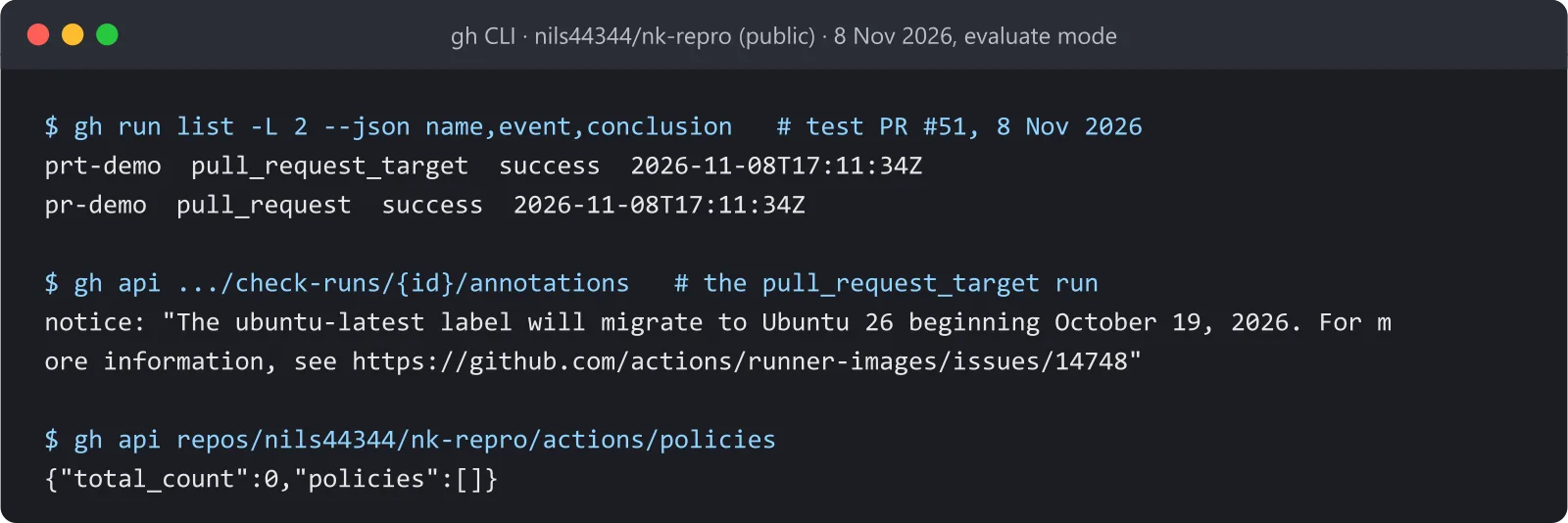
Two things matter here for anyone checking their own repositories:
- There was no warning on the run. The
pull_request_targetrun succeeded, and its only annotation was an unrelated notice about theubuntu-latestimage. Nothing in the run page or its logs said this workflow would be blocked. So don’t wait for a warning in your CI to tell you; you’ll get the failure first. - The default rule doesn’t show up as a policy.
GET /repos/{owner}/{repo}/actions/policiesreturned{"total_count":0,"policies":[]}. The block isn’t something you’ll find listed and can delete; it applies precisely because no event policy exists.
The run I made came from a branch in the same repository. The risk the rule is aimed at is pull requests from forks, and I couldn’t open one from a second account here, so I can’t say whether evaluate mode treats fork PRs differently. I re-ran it during the November 9 window.
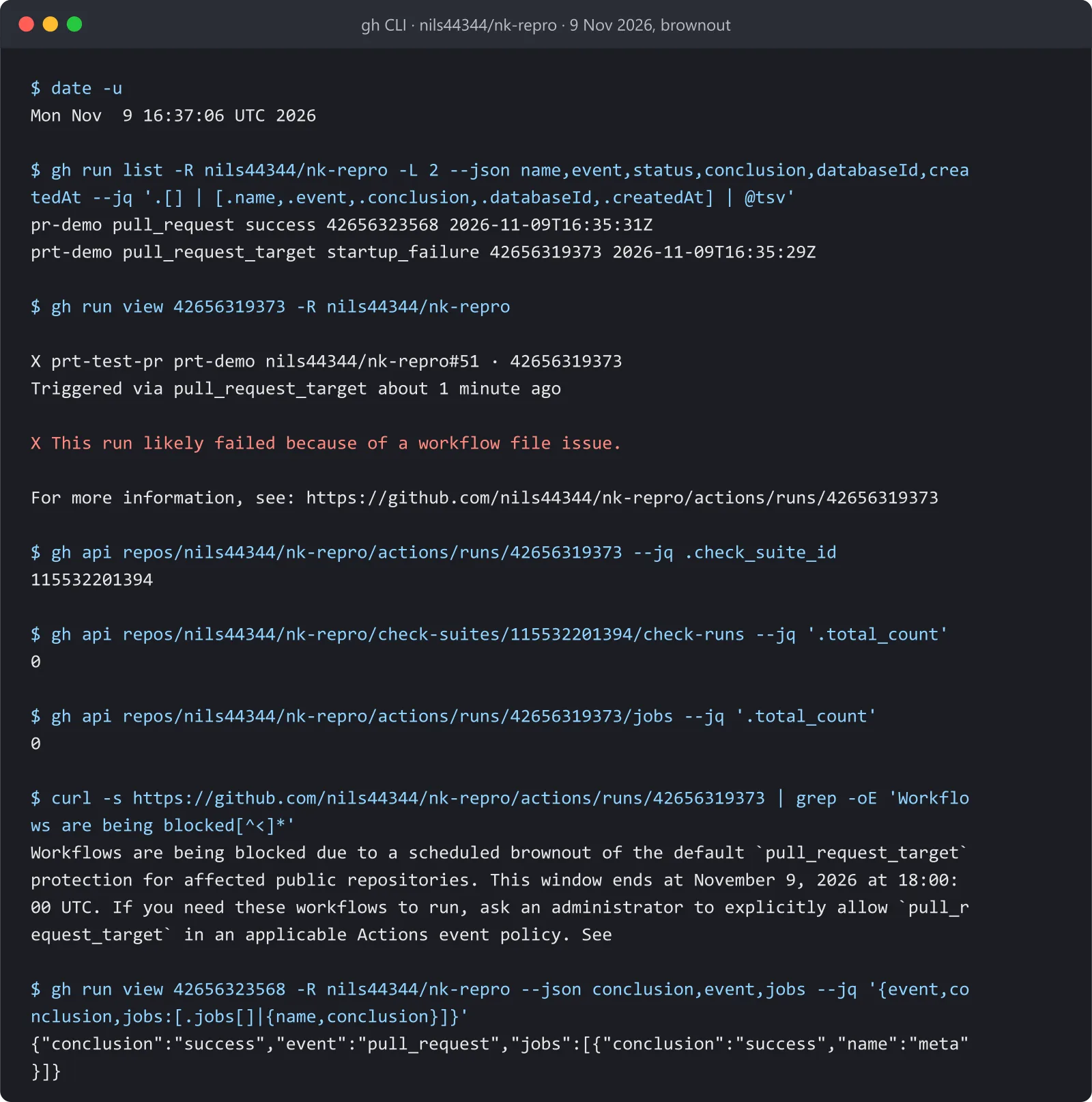
Update, November 9 (16:35 UTC): the same-repository pull request was blocked too. I pushed one commit to PR #51 and both workflows fired. The pull_request_target run ended with conclusion startup_failure and never started a job: the jobs API returned total_count: 0 and its check suite had no check runs, so there was no annotation to read from the check-runs API. gh run view only said “This run likely failed because of a workflow file issue.” The real reason was on the run page in the browser:
Workflows are being blocked due to a scheduled brownout of the default
pull_request_targetprotection for affected public repositories. This window ends at November 9, 2026 at 18:00:00 UTC. If you need these workflows to run, ask an administrator to explicitly allowpull_request_targetin an applicable Actions event policy.
The pull_request run from the same push ran normally: its one job, meta, succeeded. So the block hits the trigger, not the repository, and it covers PRs from your own branches, not only forks.
Do you use it without knowing?
Most people never typed pull_request_target themselves. It came with a workflow they copied from an action’s README:
actions/labeler, the official labelling action, is built around it: its README mentionspull_request_target18 times and has a whole section on its peculiarities.dependabot/fetch-metadatapoints to it for anything that needs a write token or secrets, which is how most Dependabot auto-merge and auto-approve workflows are set up.amannn/action-semantic-pull-request, the PR-title checker, mentions it 5 times in its README.
To find yours, search the repository: grep -rl pull_request_target .github/workflows. GitHub’s docs also point to policy insights, next to the Actions policies page in Settings, which lists the runs the rule would have blocked.
Which fix to choose
pull_request_target exists so a workflow can act on a pull request from a fork with the base repository’s secrets and a write token. That’s also why it’s being blocked: if such a workflow checks out the fork’s code and runs it, through a build, npm install or a test, the fork’s author can read your secrets. GitHub’s docs are explicit that checked-out code must only ever be treated as data.
So the deciding question is whether the workflow needs those privileges:
| Your workflow… | Do this |
|---|---|
| builds or tests the PR’s code, no secrets | switch to pull_request |
| only adds labels, comments or approvals, never runs PR code | allow pull_request_target for that file in a policy |
| needs secrets and runs PR code | split it: test on pull_request, then do the privileged part in a workflow_run workflow that treats the results as data |
| you don’t recognise it | let the block stand on December 2, and see what fails |
If you allow it, allow it narrowly. The policy’s event rule is an allowlist (“the events that can trigger Actions workflows”, in the REST docs), so target only the workflow files that need it, by path, rather than every workflow in the repository, and list every trigger that file uses.
The same policy through the API
For many repositories, the REST API is quicker than clicking through Settings. The endpoint is POST /repos/{owner}/{repo}/actions/policies (and /orgs/{org}/actions/policies for an organization), with a body like this, based on GitHub’s REST reference:
{
  "name": "Allow pull_request_target for the labeler",
  "enforcement": "active",
  "conditions": { "workflow_path": { "include": [".github/workflows/labeler.yml"], "exclude": [] } },
  "rules": [
    { "type": "restrict_action_events",
      "parameters": { "allowed_events": ["pull_request_target"] } }
  ]
}
I haven’t created this policy on my test repository yet, so treat the body as the documented shape, not a tested one. The “evaluate” enforcement value is listed as GitHub Enterprise only, so on a free account your choices are effectively active or disabled.
What I ran
On November 8, 2026: two workflows in the public nk-repro repository, prt-demo.yml (pull_request_target) and pr-demo.yml (pull_request), each printing only the event name and branch, with contents: read. They were triggered by test pull request #51 from a branch of the same repository. I read the run conclusions with gh run list, the annotations from the check-runs API, and the repository’s policies from the Actions policies API (output). The schedule and scope come from GitHub’s changelog; the policy fields from GitHub’s docs on governing workflow execution and the REST reference. The README counts were taken from each action’s README on GitHub the same evening.
On November 9, 2026 at 16:35 UTC, during the brownout: one more commit pushed to PR #51. The pull_request_target run (42656319373) and the pull_request run (42656323568) were read with gh run view, the jobs and check-runs APIs, and the run page (output). Both saved outputs are in nk-repro/prt.
— N.K., end of entry No.097