Verdict
Nothing fails to install on Python 3.10 yet. pip resolves to the last release that still supports 3.10, with no warning: numpy 2.2.6 instead of 2.5.4, pandas 2.3.3 instead of 3.1.1, Django 5.2 instead of 6.1, SQLAlchemy 2.0 instead of 2.1, and 10 more of the 47 I tried. You only see an error when you pin the newest version.
Tested on
- Python
- 3.10.22 and 3.11 (GitHub Actions setup-python)
- pip / uv
- pip 26.3 on the base Python 3.10 and 26.2.2 on the base 3.11 control (each fresh venv used its bundled pip); uv (latest on November 9, 2026)
- Packages
- 47 popular packages, newest release on PyPI on November 9, 2026
- OS
- Ubuntu (GitHub Actions)
Contents
Python 3.10 reached end of life on October 1, 2026, and the libraries were ahead of it: many popular packages already require 3.11 or 3.12 in their newest release. What surprised me is what happens when you install them on 3.10 anyway. Nothing fails. pip looks for the newest release whose Requires-Python allows 3.10, installs that without any error. So a project can sit on year-old pandas or numpy without anyone deciding that.
I installed 47 widely used packages, one at a time into a fresh 3.10 virtual environment, on November 9, 2026, and compared what I got with the newest release on PyPI:
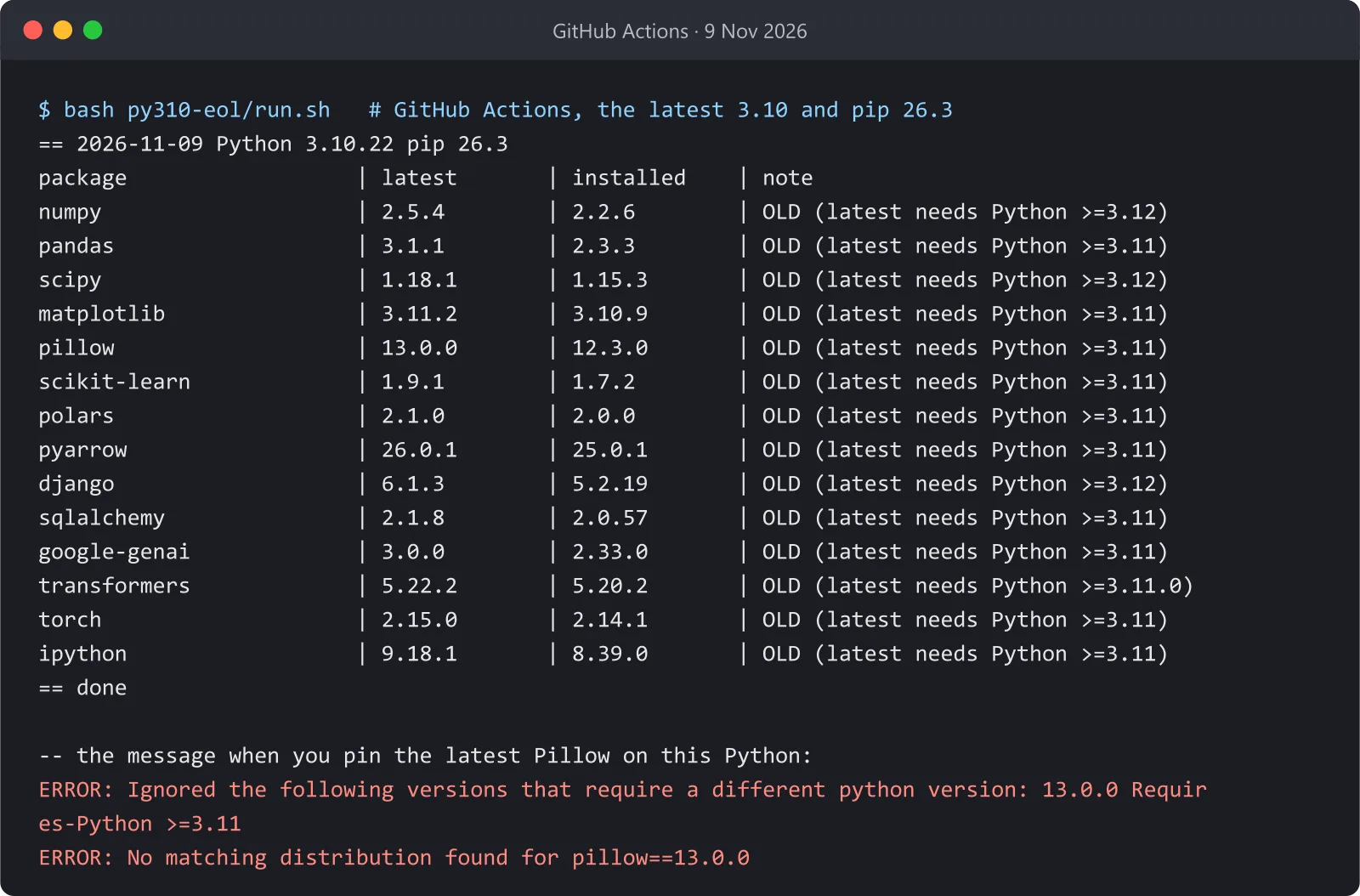
What 3.10 gets you instead
| Package | Newest on Nov 9 | Installed on 3.10 | Newest needs |
|---|---|---|---|
| numpy | 2.5.4 | 2.2.6 | ≥ 3.12 |
| scipy | 1.18.1 | 1.15.3 | ≥ 3.12 |
| Django | 6.1.3 | 5.2.19 | ≥ 3.12 |
| pandas | 3.1.1 | 2.3.3 | ≥ 3.11 |
| matplotlib | 3.11.2 | 3.10.9 | ≥ 3.11 |
| Pillow | 13.0.0 | 12.3.0 | ≥ 3.11 |
| scikit-learn | 1.9.1 | 1.7.2 | ≥ 3.11 |
| polars | 2.1.0 | 2.0.0 | ≥ 3.11 |
| pyarrow | 26.0.1 | 25.0.1 | ≥ 3.11 |
| SQLAlchemy | 2.1.8 | 2.0.57 | ≥ 3.11 |
| google-genai | 3.0.0 | 2.33.0 | ≥ 3.11 |
| transformers | 5.22.2 | 5.20.2 | ≥ 3.11 |
| torch | 2.15.0 | 2.14.1 | ≥ 3.11 |
| IPython | 9.18.1 | 8.39.0 | ≥ 3.11 |
The full table with all 47 is in the run log. On November 9 the other 33, including requests, FastAPI, pydantic, Flask, the OpenAI and Anthropic SDKs, LangChain, pytest, ruff and cryptography, still installed their newest release on 3.10. Since then, by PyPI metadata on November 16 (not a re-run), FastAPI from 0.162.6 (November 13) and LangChain 1.5.0 (November 11) also require Python 3.11, so a re-run today would show 16 of 47.
Moving to 3.11 isn’t always enough. In the same test on Python 3.11, numpy (2.4.6), SciPy (1.17.1) and Django (5.2.19) were still held back, because their newest releases need 3.12.
Some of these gaps are a whole major version: pandas 2 to 3, Django 5 to 6, google-genai 2 to 3. If you read release notes or answers written for the current version, they may describe behaviour your 3.10 environment doesn’t have, and the other way round.
When each one dropped 3.10
The end-of-life date isn’t when the trouble started. Most of these packages dropped 3.10 months before it, so a 3.10 project has been drifting behind since 2025. From each package’s release history on PyPI:
| Package | First release without 3.10 | Released |
|---|---|---|
| IPython | 9.0.0 | February 2025 |
| numpy | 2.3.0 | June 2025 |
| SciPy | 1.16.0 | June 2025 |
| Django | 6.0 (needs 3.12) | December 2025 |
| scikit-learn | 1.8.0 | December 2025 |
| pandas | 3.0.0 | January 2026 |
| matplotlib | 3.11.0 | June 2026 |
| SQLAlchemy | 2.1.0 | September 2026 |
| pyarrow | 26.0.0 | October 2026 |
| Pillow | 13.0.0 | October 2026 |
| polars | 2.1.0 | October 2026 |
| transformers | 5.21.0 | October 2026 |
| torch | 2.15.0 | October 2026 |
| google-genai | 2.34.0 | October 2026 |
Two of those are easy to miss. google-genai dropped 3.10 in a minor release, 2.34.0, so a google-genai<3 pin doesn’t keep you on the newest 2.x; on 3.10 it stops at 2.33.0. And six of them dropped 3.10 in October alone, around the end-of-life date (pyarrow, Pillow, polars, transformers, torch and google-genai), so a 3.10 environment built at the start of October and one built today differ in six packages, with no change to your requirements.
The error you only see when you pin
pip only complains when you ask for a version 3.10 can’t have. Pinning the newest Pillow:
ERROR: Ignored the following versions that require a different python version: 13.0.0 Requires-Python >=3.11
ERROR: Could not find a version that satisfies the requirement pillow==13.0.0
ERROR: No matching distribution found for pillow==13.0.0
uv says it more directly, for the same pin:
error: No solution found when resolving dependencies
  cause: Because the current Python version (3.10.22) does not satisfy Python>=3.11 and pillow==13.0.0 depends on Python>=3.11, ...
So a lockfile or requirements.txt written on 3.11 or newer will fail on 3.10 with these messages, while an unpinned install on 3.10 succeeds with older versions. That difference is the usual reason “it installs on my machine” and “CI can’t resolve it” happen in the same project.
To see whether your environment is being held back, compare what you have with the newest release on PyPI: python -m pip show <package> gives your version, and https://pypi.org/pypi/<package>/json lists the newest release and its requires_python. If the newest release needs a newer Python than you run, and pip install -U doesn’t move it, your Python version is what holds it back, not your requirements. For a shared project, also check which Python CI and Docker images use: a python:3.10 base image keeps installing these older releases long after the developers’ own machines have moved on, and the two will report different versions for the same requirements file. The fix is moving the project to 3.11 or newer (3.12 if you need the newest numpy, SciPy or Django).
The run
GitHub Actions ubuntu-latest, November 9, 2026, with Python 3.10.22 from actions/setup-python (the runner’s base pip was 26.3, and 26.2.2 on the 3.11 control; each package went into a fresh venv, which uses the pip bundled with that Python, and the log does not print that pip). Each package was installed alone into a fresh venv with --only-binary :all:, and the installed version was compared with the newest release on PyPI and its Requires-Python. The same script ran on Python 3.11 as a control. The release dates come from each package’s release history on PyPI, read the same day. The script and full output are public.
— N.K., end of entry No.106